
Memory Thematic ETF Launches: The Capital Siphoning Effect
2026-11-09

AI infrastructure has increasingly become a portfolio concept rather than a single technology category. GPUs, custom accelerators, networking equipment, advanced packaging, power systems, data centers, and high-bandwidth memory all participate in the same investment narrative, but they do not respond to the cycle in exactly the same way. For investors examining AI infrastructure ETFs and related index derivatives, the composition of holdings can therefore reveal more than simple exposure to artificial intelligence. It can also provide a useful window into how institutional capital views the strategic importance of memory within the broader computing stack.
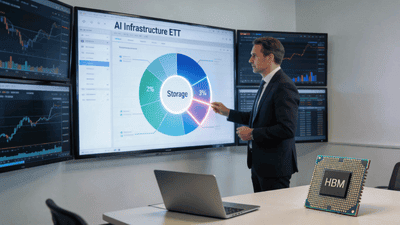
Memory is particularly interesting because it sits between infrastructure demand and semiconductor cyclicality. HBM has become essential to many high-performance AI accelerator architectures, while conventional DRAM and enterprise storage remain important as data-center workloads expand. This creates a complicated relationship between AI infrastructure ETFs, memory manufacturers, equipment suppliers, and the indexes or derivatives designed to track these themes. The institutional memory view is not necessarily about owning memory companies directly. It is about understanding how memory exposure is embedded, weighted, diversified, and repriced inside the broader AI infrastructure investment framework.
The first step is to look beyond the label of an ETF. An AI infrastructure fund may contain semiconductor designers, foundries, memory producers, equipment companies, networking suppliers, cloud infrastructure firms, and data-center operators. Two funds can both describe themselves as AI infrastructure products while having substantially different economic sensitivities.
For memory analysis, the relevant question is not simply whether a fund owns memory manufacturers. It is how much of the portfolio's earnings sensitivity is connected to memory demand. A semiconductor company may have a relatively small direct memory business while still benefiting from HBM adoption, advanced packaging, or higher server content. Conversely, a company with significant memory exposure may behave differently from the broader AI infrastructure group because conventional memory pricing remains strongly influenced by inventory and capacity cycles.
This makes portfolio holdings a useful starting point for identifying hidden memory exposure. Institutional investors often evaluate an ETF through sector allocation, company concentration, geographic exposure, market capitalization, and earnings sensitivity. The same framework can be applied to AI memory.
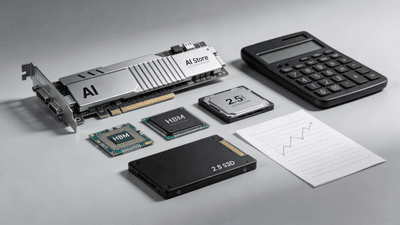
Traditional memory analysis often revolves around DRAM and NAND supply, demand, inventory, utilization, and pricing. HBM adds another dimension because it is closely tied to advanced AI accelerators. Its economic characteristics are therefore partly determined by computing architecture rather than only by conventional memory cycles.
For AI infrastructure ETFs, HBM can function as a bridge between compute and memory. A portfolio heavily exposed to AI accelerators may indirectly carry substantial HBM demand sensitivity even when the fund has limited direct ownership of memory companies. The accelerator cannot deliver its expected performance without an appropriate memory architecture, bandwidth, packaging configuration, and power environment.
This relationship creates a broader institutional interpretation of memory. Instead of viewing memory as a standalone semiconductor subsector, investors can treat it as an infrastructure constraint. If computing performance continues to scale, memory bandwidth and capacity become increasingly important components of system-level economics.
That does not mean memory prices must continuously rise. It means that the strategic role of memory can increase even while individual memory cycles remain volatile. ETF holdings can help distinguish between these two ideas: structural importance and cyclical profitability are related, but they are not identical.
ETF holdings become especially informative when examined through weighting rather than simple constituent counts. A fund may hold dozens of semiconductor companies, but a small number of large positions can dominate its economic behavior. If the largest holdings are companies with strong exposure to AI accelerators, HBM, networking, or advanced packaging, the fund may carry more memory-related sensitivity than its sector labels suggest.
Market-cap-weighted products naturally concentrate capital toward companies that have already achieved significant scale or market value. This can create an indirect preference for established AI infrastructure leaders. Equal-weighted or factor-based indexes can produce a different distribution of exposure, potentially giving smaller equipment, memory, or infrastructure companies a larger influence.
Institutional investors may therefore compare several layers of ETF construction. The first is the number of memory-related constituents. The second is their actual portfolio weight. The third is their contribution to earnings sensitivity. The fourth is their correlation with memory prices and semiconductor indexes.
A company representing only a modest percentage of an ETF can still become important if its earnings are highly sensitive to HBM pricing or capacity expansion. Conversely, a large semiconductor position may have limited memory sensitivity if its business is dominated by other products.
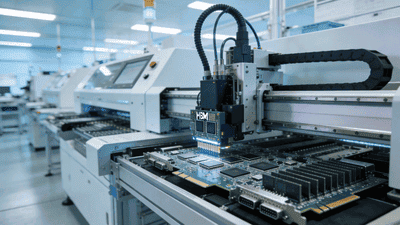
Memory exposure does not end with memory manufacturers. AI infrastructure ETFs may also include semiconductor equipment companies whose businesses benefit from higher wafer starts, process complexity, advanced packaging, or capacity expansion.
This creates a second-order memory relationship. When AI demand encourages HBM production expansion, manufacturers may increase investment in specialized process technology, advanced packaging, testing, and manufacturing capacity. Equipment suppliers can therefore participate in the memory investment cycle without being directly exposed to memory selling prices.
The distinction is important for institutional analysis. Memory manufacturers tend to be more directly exposed to pricing and inventory conditions, while equipment companies may be more closely linked to capital expenditure plans. These two exposures can move together during an expansion but diverge when manufacturers become cautious about adding capacity.
As a result, an AI infrastructure ETF with a significant equipment allocation may provide a different expression of the memory cycle than a specialized memory ETF. One is potentially more connected to future capacity creation; the other may be more sensitive to current pricing and utilization.
AI infrastructure indexes and their derivatives introduce a market-based layer that is different from the underlying holdings. Futures and options reflect not only expectations about company earnings but also volatility, positioning, liquidity, and the cost of expressing a view.
For memory investors, index derivatives can be particularly useful for understanding how the market prices uncertainty around AI infrastructure. When options become more expensive, the market is assigning greater value to protection or directional convexity, although elevated implied volatility does not reveal the direction of the eventual move by itself.
Derivatives also change how institutional investors can manage exposure. An investor may hold an AI infrastructure ETF for structural exposure while using index options to manage short-term volatility. Another investor may use derivatives to express a view on the broader AI cycle without directly selecting individual memory companies.
This creates an important distinction between ownership and positioning. ETF holdings show what the fund owns. Derivatives can show how market participants are managing the risk associated with that exposure. Looking at both can provide a more complete picture of institutional sentiment toward AI infrastructure and memory.

Institutional investors rarely evaluate concentration only at the company level. They also examine concentration by technology, geography, supply chain position, and economic driver. An ETF containing several different semiconductor companies may appear diversified while still being highly dependent on the same AI spending cycle.
For example, accelerator designers, HBM suppliers, advanced packaging companies, and semiconductor equipment manufacturers can all benefit from the same wave of AI capital expenditure. Their individual businesses are different, but their financial performance may become increasingly correlated when hyperscale customers accelerate infrastructure investment.
This creates what might be called hidden thematic concentration. A portfolio can contain many names while maintaining strong exposure to one dominant economic narrative.
From a memory perspective, this is especially relevant when AI infrastructure investment becomes heavily dependent on high-bandwidth memory. The direct memory holdings may be relatively limited, but the economic chain surrounding them can become much broader. The institutional question then becomes whether the ETF is genuinely diversified or simply diversified across companies participating in the same memory-intensive AI buildout.
It would be a mistake to interpret AI memory only through HBM. Conventional DRAM remains important for servers, networking systems, PCs, and other computing applications, while NAND supports enterprise storage and the growing data infrastructure required to process and retain AI workloads.
AI infrastructure ETFs can therefore have several distinct memory transmission channels. HBM is connected to accelerator bandwidth. Server DRAM is connected to system capacity. Enterprise SSDs are connected to storage requirements and data-center expansion. These markets can experience different pricing cycles even when they are influenced by the same broad technology investment trend.
This distinction matters when evaluating ETF performance. A fund can benefit from AI-related memory demand while remaining exposed to weakness in consumer electronics or conventional storage. Conversely, a broad memory recovery can support semiconductor sentiment even when the AI component of demand is temporarily less dynamic.
The institutional view therefore tends to separate structural AI demand from cyclical memory demand. The two interact, but neither completely explains the other.
ETF indexes are not static. Rebalancing rules can change the portfolio's sensitivity to different parts of the semiconductor ecosystem. Companies that experience rapid increases in market capitalization can become larger positions in market-cap-weighted products, while thematic methodologies may adjust constituents according to revenue exposure, technology classifications, or other criteria.
This creates an interesting feedback mechanism. Strong performance can increase a company's weight, which can increase its influence on subsequent ETF performance. At the same time, new companies can enter the thematic universe as their AI-related businesses become more significant.
For memory analysis, this means that ETF exposure should be observed over time rather than treated as a permanent characteristic. A fund that had limited memory sensitivity several years ago can become much more exposed to HBM, advanced packaging, or server infrastructure as the industry evolves.
Institutional investors may therefore track changes in holdings alongside changes in index methodology. The methodology explains what the fund is designed to capture; the actual holdings reveal how that design is being expressed in a particular period.
The institutional memory view becomes particularly interesting when AI capital expenditure begins to normalize. A slower spending environment does not necessarily imply a collapse in memory demand. Instead, the transmission mechanism may change.
During a strong expansion, investors may focus on accelerator shipments, HBM capacity, data-center construction, and equipment orders. During normalization, attention can shift toward inventory levels, utilization rates, customer concentration, pricing discipline, and return on invested capital.
This can create different outcomes across ETF holdings. High-growth infrastructure companies may become more sensitive to valuation changes, while memory producers may respond more directly to pricing and inventory data. Equipment companies may react to changes in capital expenditure expectations before the physical memory market shows clear deterioration.
Index derivatives can amplify this transition because investors often use options and futures to adjust exposure quickly when expectations change. Consequently, ETF performance can sometimes move ahead of fundamental memory indicators, creating a gap between market pricing and reported semiconductor data.
A useful framework begins with five questions. First, how much direct memory exposure exists inside the ETF? Second, how much indirect exposure comes through accelerators, packaging, networking, equipment, and data-center infrastructure? Third, how concentrated is that exposure among the largest holdings? Fourth, how does the index methodology change those weights over time? Fifth, how are derivatives pricing volatility around the same thematic basket?
The answers can reveal whether an AI infrastructure ETF is primarily a compute vehicle, a diversified semiconductor vehicle, a memory-sensitive infrastructure vehicle, or some combination of all three.
It is also useful to compare holdings with physical indicators. HBM capacity expansion, DRAM contract pricing, NAND pricing, server demand, inventory levels, semiconductor utilization, equipment spending, and hyperscaler capital expenditure can provide different pieces of the same puzzle. No single indicator is sufficient because AI infrastructure has become a multi-layered ecosystem.
One interpretation is that memory is becoming a structural bottleneck in AI computing. Under this view, HBM and related technologies become increasingly important to system performance, giving memory exposure a more strategic role within AI infrastructure portfolios.
A second interpretation is that memory remains fundamentally cyclical despite its growing strategic importance. AI can strengthen the demand foundation, but capacity additions, inventory corrections, and pricing competition can still create substantial earnings volatility.
A third interpretation is that the most important exposure lies between the two extremes. Institutional portfolios may increasingly combine memory producers, equipment suppliers, accelerator companies, and infrastructure firms to capture the broader AI compute cycle rather than relying on a single semiconductor subsector.
These interpretations can coexist. An investor can believe that memory has become strategically more important while also recognizing that memory companies remain exposed to cyclical supply and pricing dynamics.
AI infrastructure ETF holdings provide more than a list of companies. They offer a map of how institutional capital is connecting computing power, memory bandwidth, semiconductor manufacturing, equipment investment, networking, and data-center infrastructure.
For memory investors, the most useful perspective is often not whether an ETF is labeled as an AI fund or a semiconductor fund. The more revealing question is where memory enters the economic chain and how much influence that exposure has on the portfolio.
HBM has made memory increasingly inseparable from high-performance computing, while conventional DRAM and NAND continue to connect AI infrastructure with the broader semiconductor cycle. Equipment companies add a capital-expenditure dimension, while index derivatives introduce a layer of volatility and positioning that can move faster than physical industry data.
The institutional memory view is therefore best understood as a layered framework. Direct holdings show ownership, indirect holdings reveal supply-chain exposure, index construction determines concentration, rebalancing changes sensitivity over time, and derivatives reveal how market participants are pricing uncertainty around the theme.
As AI infrastructure develops, these layers are likely to become increasingly interconnected. The most informative analysis will not treat memory, compute, equipment, and ETFs as separate stories, but as different expressions of the same evolving digital infrastructure cycle.